
 Sony FCB camera block
As a module of the Sony FCB-9500 series camera, the biggest difference between FCB-EV9500M and FCB-EW9500H, FCB-EV9500L lies in the video output pixels and output interfaces. FCB-EV9500M outputs 1080P full HD quality through the MIPI interface. What are the differences in its detailed specifications? Xuanzhan Technology, an official authorized dealer of Sony (China), will explain it all to you in one go, allowing you to enjoy it from beginning to end.
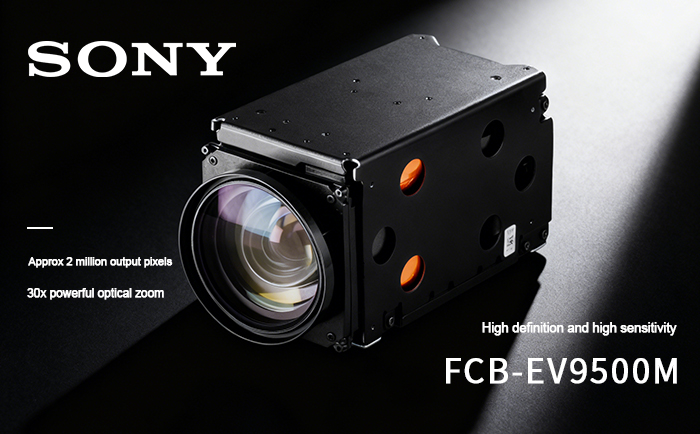
Sony FCB-EV9500M Technical Specification Manual Explanation-1
1. Cover Page and Summary of Specification
| Image sensor | Progressive scan CMOS image sensor 1/1.8 type “STARVIS” | ||
| Number of total pixels (H) x(V) | 2781 x1632,4.53M[pixels] | ||
| Number of effective pixels(H) x (V) | 2712 x1538,4.17M[pixels] | ||
| Number of recommended recording pixels(H) x(V) | 2688 x1520,4.09M[pixels] | ||
| Enhanced optical zoom | Magnification | 30[times] | |
| Angle of view [degree] | Horizontal | 58.1 (Wide), 2.3 (Tele) | |
| Vertical | 34.8 (Wide), 1.4 (Tele) | ||
| Diagonal | 65.1 (Wide), 2.7 (Tele) | ||
| F value | F1.6 (Wide) to F4.8 (Tele) | ||
| Control mechanics | Zoom motor | Stepping motor | |
| Focus motor | Stepping motor | ||
| Iris | Stepping motor | ||
| IRCF | Meter Galvano method | ||
| Output mode | [FHD] 1080p/60,1080p/59.94,1080i/60,1080i/59.94,1080p/50,1080i/50, 1080p/30,1080p/29.97,1080p/25 [HD] 720p/60,720p/59.94,720p/50,720p/30,720p/29.97,720p/25 | ||
| Synchronized Codes | MIPI CSI-2, “MIPI Alliance Standard for Camera Serial Interface 2 (CSI-2) Version 1.01 Revision Nov 2010” | ||
| I/O pins | Image signal Output | Compliant with MIPI (1080p,1080i,720p) | |
| Control signal I/O | VISCA protocol (CMOS 3.3 [V], 5.5V tolerance) | ||
| Power, others | Power supply | DC 7.0 [V]to DC 12.0 [V] | |
| Power consumption | 5.0 W (Typ. DC IN 7-12V, zoom/focus inactive)) | ||
| Storage temperature | -20 to +60 [˚C] / 20 [%] to 95 [%] Absolute humidity: 36 [g/m3] | ||
| Operating temperature | -5 to +60 [˚C] / 20 [%] to 80 [%] Absolute humidity: 36 [g/m3] | ||
| Package dimensions | 56 [mm] x64 [mm] x 125 [mm ] | ||
| Package mass | Approx. 439[g] | ||
2. Function
| Exposure | Full Auto / Gain Limit Setting / Shutter Priority / Iris Priority / Manual / EV compensation |
|
White Balance | Auto / ATW / Indoor / Outdoor / One Push WB / Manual / One push Triger / Outdoor Auto / Sodium Vapor Lamp Auto / Sodium Vapor Lamp / Sodium Vapor Lamp Outdoor Auto |
| Focus | Auto / Manual / One Push Trigger /Full Scan one push trigger / Near Limit |
| Wide Dynamic Range | Yes |
| Visibility Enhancer | Yes |
| Noise Reduction | 3D / 2DNoise Reduction |
| ICR (Day and Night) | Yes |
| Image Stabilizer (Super) | Yes |
| Image Stabilizer (Super+) | Yes |
| Slow AE Response | Yes |
| High Sensitivity | Yes |
| Gamma | Standard / Straight gamma |
| D-ZOOM | 12x |
| Defog | Yes |
| Picture Effect | Black & White |
| Spherical Privacy Zone Masking | Yes |
| E-FLIP | Yes |
| HLC | Yes |
3. Connection specification
3.1 Connector and Pin Assignment
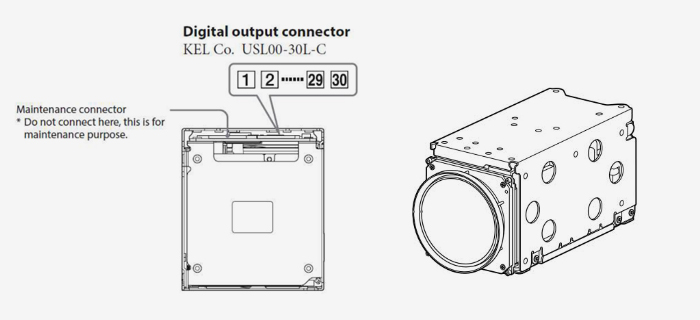
Sony FCB-EV9500M Technical Specification Manual Explanation-2
| Pin No. | Name | Level |
| 1 | GND | |
| 2 | NC | |
| 3 | NC | |
| 4 | GND | |
| 5 | NC | |
| 6 | NC | |
| 7 | GND | |
| 8 | NC | |
| 9 | NC | |
| 10 | GND | |
| 11 | NC | |
| 12 | NC | |
| 13 | GND | |
| 14 | CSID3N | [O]: MIPI CSI 3- |
| 15 | CSID3P | [O]: MIPI CSI 3+ |
| 16 | CSID2N | [O]: MIPI CSI 2- |
| 17 | CSID2P | [O]: MIPI CSI 2+ |
| 18 | CSICN | [O]: MIPI CSI Clock- |
| 19 | CSICP | [O]: MIPI CSI Clock+ |
| 20 | CSID1N | [O]: MIPI CSI 1 |
| 21 | CSID1P | [O]: MIPI CSI 1+ |
| 22 | CSID0N | [O]: MIPI CSI 0- |
| 23 | CSID0P | [O]: MIPI CSI 0+ |
| 24 | VISCA_RxD | [I]: CMOS 3.3[V] (Low; Max1.0[V], High; Min2.3[V]) 5.5V tolerance |
| 25 | VISCA_TxD | [O]: CMOS 3.3[V] (Low; Max0.1[V], High; Min2.4[V]) |
| 26 | RESET | [I]: Reset; LOW (GND), Unreset ; OPEN (High Impedance) |
| 27 | DC_IN | [I] 7 to12[V] DC |
| 28 | DC_IN | [I] 7 to12[V] DC |
| 29 | DC_IN | [I] 7 to12[V] DC |
| 30 | DC_IN | [I] 7 to12[V] DC |
3.2 MIPI PIXEL DATA FORMAT
Compliant with MIPI (1080p,1080i,720p)
- MIPI D-PHY, “MIPI_D-PHY_specification_v01-00-00, May 14, 2009”
- MIPI CSI-2, “MIPI Alliance Standard for Camera Serial Interface 2 (CSI-2) Version 1.01 Revision Nov 2010”
| Output Format | MIPI CSI Clock | Pixel clock | |
| 1080p/60 | RGB | 445.5 MHz | 148.5 MHz |
| YPbPr | 297 MHz | ||
| 1080p/59.94 | RGB | 445.5 MHz | 148.5/1.001 MHz |
| YPbPr | 297 MHz | ||
| 1080p/50 | RGB | 445.5 MHz | 148.5 MHz |
| YPbPr | 297 MHz | ||
| 1080i/60 | RGB | 297 MHz | 74.25 MHz |
| YPbPr | —— | —— | |
| 1080i/59.94 | RGB | 297 MHz | 74.25/1.001 MHz |
| YPbPr | —— | —— | |
| 1080i/50 | RGB | 297 MHz | 74.25 MHz |
| YPbPr | —— | —— | |
| 1080p/30 | RGB | 297 MHz | 74.25 MHz |
| YPbPr | 297 MHz | ||
| 1080p/29.7 | RGB | 297 MHz | 74.25/1.001 MHz |
| YPbPr | 297 MHz | ||
| 1080p/25 | RGB | 297 MHz | 74.25 MHz |
| YPbPr | 297 MHz | ||
| 720p/60 | RGB | 297 MHz | 74.25 MHz |
| YPbPr | 297 MHz | ||
| 720p/59.94 | RGB | 297 MHz | 74.25/1.001 MHz |
| YPbPr | 297 MHz | ||
| 720p/50 | RGB | 297 MHz | 74.25 MHz |
| YPbPr | 297 MHz | ||
| 720p/30 | RGB | 297 MHz | 74.25 MHz |
| YPbPr | 297 MHz | ||
| 720p/29.97 | RGB | 297 MHz | 74.25/1.001 MHz |
| YPbPr | 297 MHz | ||
| 720p/25 | RGB | 297 MHz | 74.25 MHz |
| YPbPr | 297 MHz | ||
Number of Lanes: 4 data lanes fixed
4 Detailed Specifications
4.1 Sensor Specifications
| Image sensor | Progressive scan CMOS image sensor |
| Unit cell size (H) x (V) | 2.9 [um] x 2.9 [um] |
| Number of total pixels (H) x (V) | 2781×1632 453 万[pixels] |
| Number of effective pixels (H) x (V) | 2712×1538 417 万[pixels] |
| Scan method | Progressive scan |
| Color filter | Primary color Bayer arrangement |
| Shutter | Rolling shutter (NOT Global shutter) |
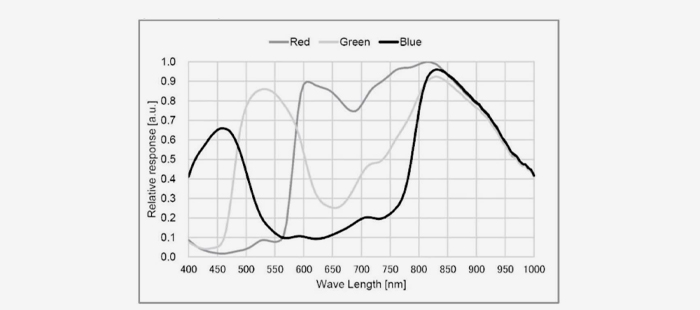
Sony FCB-EV9500M Technical Specification Manual Explanation-3
4.2 Lens Specifications (*Design Specifications)
| Configuration | 12 groups, 17 elements |
| F number | 1.6(Wide) to 4.8 (Tele) |
| Focal length (35 [mm] converted) | 6.5 [mm] to 162.5 [mm] (31.2 [mm] to 780 [mm]) |
| TV distortion | -1.6 [%] (Wide) / +1.00 [%] (Tele) ad infinity*2 |
| Focal range | 100 [mm] to infinity (Wide) 1200 [mm] to infinity (Tele) |
Note) * The above values of field of view are calculated based on the maximum recording pixel area of image
sensor.They differ from the ones on 2D outline drawing, which are calculated based on the effective pixel area of image
sensor and include the margin for the assembly tolerance.
*2 Distortion Correction OFF
4.3 Camera specifications
– S/N
Typ.value
More than 50 [dB] (Black, Gain 0 [step], Shutter 1/30)
– Minimum Illumination
50 [IRE], ICR OFF, IRIS OPEN, AGC MAX(28[Step])
Typ.value
FHD Mode 30[fps] mode
Hi Sens Off 0.09[lx]
Hi Sens ON 0.009[lx]
– White Balance
AWB (Auto White Balance) mode 2500[k]- 7500[k]
ATW (Auto Tracing White Balance) mode 2000[k]- 10000[k]
– Camera Horizontal Level
When setting up the camera and object horizontally, screen should be ±3 [˚] of the horizontal line of the monitor.
– Optical Axis Gap
When zooming from Tele end to Wide end, the gap of screen center object on Tele end is in radius circle of 8% or
less of short side of monitor screen.
– Image Vibration
When zooming from Tele end to Wide end, the gap of screen center is 2.0[mm] or less on 21[ inch] monitor
– Dirt and Scratch Specifications
No denser than density sample
[Conditions]
1. Zoom: Wide end, Focus: ∞
2. Aperture: F4 fixed
3. WB: One push
4. Light viewer (500 to 1000[cd/m2])
Image on full screen
1. Density sample: below
– Resolution
FHD:Typ. value
Position Wide Tele
Center 950 or more [TV lines] 750 or more [TV lines]
Image height (70%) 850 or more [TV lines] 650 or more [TV lines]
– TV Distortion (Distortion Correct ON)
±2[%]
– Vibration Correction Frequency
1 to 20 [Hz]
4.4 Absolute Maximum supply voltage
| Item | Signal | Min. | Typ. | Max. | Unit |
| Supply voltage | DC IN※ | -0.5 | —— | +22.0 | [V] |
※FCB input terminal part
4.5 Operating Conditions
| Item | Signal | Min. | Typ. | Max. | Unit |
| Supply voltage | DC IN※ | 7.0 | 9.0 | 12.0 | [V] |
※FCB input terminal part
4.6 Power Consumption
(Measured conditions: Room temperature, typical voltage, high speed frame rate mode as stable operation)
| Item | Signal | Ave(※1) | Max(※2) | Unit |
| Power Supply | DC IN 7.0 [V] | 4.96 | 6.67 | [W] |
| DC IN 9.0 [V] | 4.92 | 6.55 | ||
| DC IN 12.0 [V] | 4.92 | 6.55 |
※1:steady state
※2:during motor operation(Lens Actuators),but ICR Off
4.7 Lens Durability
(At Room temperature)
ZOOM 1,000,000 [Wide-Tele cycles]
FOCUS 2,000,000 [Near-∞ cycles]
Iris 500,000 [Open-Close cycles]
IR motor 20,000 [On-Off cycles]
5 Electrical Characteristics
5.1 AC Characteristics
Compliant with MIPI (1080p,1080i,720p)
5.2 VISCA (CMOS (3.3V), 5.5V tolerance)
RxD High : 2.3 [V] or more Low: 1.0 [V] or less
TxD High : 2.4 [V] or more Low: 0.1 [V] or less
5.3 MTBF
4.9 [years] (without LENS)
5.4 Environmental Test (Under the Condition of 10 Cartons)
Drop test : Test sequence and drop height (Each 1 times total 11 times)
5.5 Power Supply Condition
8[msec] or less
6 Handling Precautions
6.1 Operating Temperature
Make sure that the temperature inside the equipment does not exceed the recommended operating temperature
6.2 Durability of the Image Sensor
The on-chip color filter of the sensor may be decolorized if a large amount of light enters into the sensor. Such
conditions of use should be avoided as no product warranty is given for de-colorization. Be sure to take protective
measurements against continuous exposure to intense light.
6.3 ESD Protection
Anti-ESD measures should be taken for this camera module in the same manner as semiconductor devices.
(1) Either handle bare handed or use non-chargeable gloves, cloth or material. Also use conductive shoes.
(2) When handling directly use a wrist strap.
(3) Install grounded conductive mats on the floor and working table to prevent the generation of static electricity.
(4) Discharge using ionized air or other means is recommended when handling this camera module.
6.4 Storage and Operating Environment
Avoid storage or use under high temperature, high humidity and dusty conditions.
6.5 Mechanical Strength
This camera module is a precision optical part, so care should be taken not to apply excessive mechanical shock or
force.
6.6 Remodeling
Any remodeling or process at customers should be avoided. No product warranty will be granted if the product is once
remodeled or processed.
6.7 Flash memory
The data in the Flash Memory should not be modified or overwritten. Once they are modified or overwritten, no
product warranty may be able to be given.
6.8 White Pixels
The image-sensing device is vulnerable to natural radiation such as cosmic radiation that may cause incidental defect
resulting in white pixel. Although these white pixels are corrected during the final inspection and adjustment process of
the camera module production, a minor number of the product might be affected during the storage and shipment, and
“white pixel” may appear on incoming stage at customer production site. As the occurrence of white pixels is due to
natural behavior, it’s beyond supplier’s control.
6.9 Vertical line noise in low light condition
Rarely a vertical line noise may happen in the case when a gain sets up in the low light condition.
It’s not a malfunction but the characteristic of CMOS Image Sensor
6.10 Safety Standards
This product is manufactured as an unfinished product and no particular safety standard is applicable to this product
alone. Users should ensure that finished products using this camera module conform to applicable safety standards.
6.11 Location of Use and Storage
Do not shoot extremely bright objects (lights or sun) for long hours. In addition, please refrain from using or storing
at the following locations.
– Extremely hot or cold place (Operating temperature: -5˚C to +60˚C(23°F to 140°F))
– Near TV/radio station which produces intense radio emission
– The place where is affected by reflects of fluorescent light or light from windows
– Under unstable illumination (Flickers will be generated)
– Place with intense vibration
– Where it is subject to radiation from laser beams
6.12 When using in outdoor camera
– The outdoor camera should install inside direct lightning protection zone. Lightning rod is mandatory for camera
install outside direct lightning protection zone.
– Surging protector for power supply and signal port must install for outdoor camera. The distance between surging
protector and camera should not longer than 0.5m.
– Shielded cable for power supply and signal should be use for outdoor equipment. The cable should lay inside iron
conduit. The conduit should be well grounded.
– Cable should lay under the eaves for outdoor engineering, Aerial cable is prohibited.
– The design of ground for outdoor equipment and cable should combine with ground of building and conform to
national and industry standard.
– The ground resistance must not exceed 4Ω when use independent ground. The area of ground cable must exceed
25mm2