In medical scenarios such as surgical operations, endoscopic procedures, and interventional treatments, the off-axis surgical video camera serves as a "second pair of eyes", playing a crucial role in recording the surgical process, live-streaming for remote consultations, and providing teaching demonstrations. Surgeons need to precisely observe the details of the surgical area and the trajectories of instruments through the camera's view, remote experts rely on clear images to offer guidance, and teaching scenarios require the reproduction of real surgical procedures.
The importance of the off-axis surgical field camera in medical operations is beyond doubt. However, a common misconception is that only the on-axis surgical video camera under the shadowless lamp is significantly affected by the light spot interference, while the off-axis camera is either not affected at all or the interference is negligible. In fact, this view is not accurate.
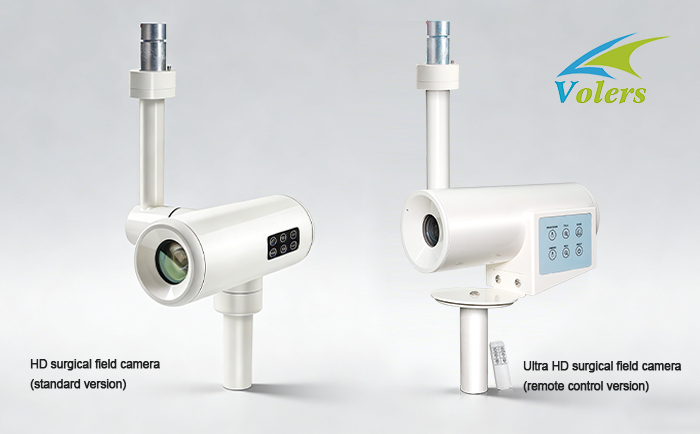
Does the off-site surgical video camera need to address the issue of light spots?-1
No matter where the camera is placed in the surgical field, as long as there are multiple high-intensity light sources in the surgical environment (such as the main shadowless lamp, auxiliary lighting, endoscope light source, etc.), light spots may be formed in the lens due to direct, reflected or scattered light. Although the side-placed camera avoids some direct light, it is still disturbed by the reflection of instruments, high-brightness areas on the tissue surface and stray light in the environment, affecting the clarity and color authenticity of the image.
I. Why is the light spot a "fatal shortcoming" for surgical visualization?
The particularity of the medical environment makes the light spot problem more difficult to solve and more crucial than in ordinary scenarios:
1. The surgical environment has complex lighting: Strong directional light sources such as shadowless lamps and cold light sources directly illuminate the surgical area, and the mirror-like reflections from instruments (forceps, hemostatic forceps) and implants (metal stents, orthopedic plates) can easily produce high-intensity light spots;
2. The surgical area requires the utmost attention to detail: Millimeter-level vascular, neural, and tissue stratification must be clearly presented. Light spot occlusion may lead to misidentification of key structures, directly affecting surgical safety.
3. Diverse and demanding imaging uses: Surgical records must serve as evidence in medical disputes, remote consultations require experts to clearly see details, and teaching demonstrations need to accurately reproduce the real surgical field. Light spots can cause the images to lose their clinical value.
Traditional solutions (such as adding filters or adjusting the angle) have limited effects: Filters can reduce the brightness and color fidelity of the image, and adjusting the angle may deviate from the optimal surgical field shooting position, and cannot solve the problem of light spots from the root.

Does the off-site surgical video camera need to address the issue of light spots?-2
II. Medical-grade Anti-Glare Technology: Ensuring a Clear Surgical Field of View
Addressing the core pain points in medical scenarios, professional off-axis
surgical video cameras have made breakthroughs in three key technologies to completely solve the problem of glare:
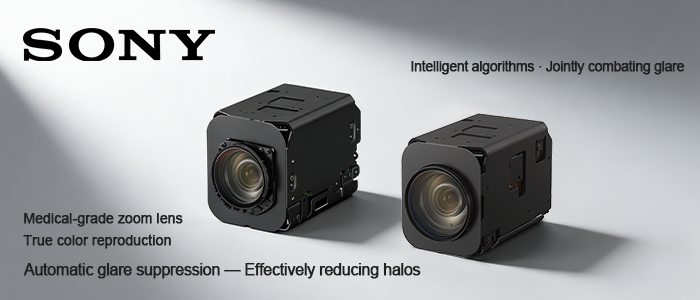
1. Medical-grade Zoom Lens: True Color Reproduction
In medical application scenarios, the lighting conditions are complex, and there are strict requirements for color reproduction and imaging details. Therefore, it is recommended to prioritize the use of professional camera modules equipped with medical-grade zoom lenses. For example, models such as the Sony FCB-ER8530 and FCB-EV9520L in the FCB series not only support fast auto-focusing but also ensure the output of true-to-life colors and clear details in high-brightness environments. They effectively suppress glare caused by surgical lights and reflections from instruments, thereby providing stable and reliable high-quality visual support for medical imaging.
2. Automatic Bright Light Suppression: Effectively Reducing Glare
The Sony FCB-9520L is equipped with an automatic bright light suppression function. By continuously monitoring overexposed areas in the image, it dynamically adjusts local exposure parameters. Combined with wide dynamic range (WDR) algorithms and multi-layer coated lens groups, it can effectively reduce glare caused by instrument reflections and tissue fluid refractions. This provides clear and artifact-free visual support for minimally invasive surgeries, endoscopic examinations, and other scenarios, assisting doctors in making precise decisions.
3. Intelligent Algorithm: Jointly Combating Light Spots
The FCB-ER9500, FCB-EV9520L and FCB-9500 series in Sony's FCB camera modules all feature regional automatic exposure, focusing, and white balance functions. For the light spot areas in the picture, specific parameters are set to achieve better color reproduction, reducing the light spots while maintaining the normal brightness and details of other parts of the surgical area. Coupled with an ultra-wide dynamic range, it can solve the blurriness caused by the coexistence of overexposure and underexposure environments, and output high-definition image frames.
Does the off-site surgical video camera need to address the issue of light spots?-3
Summary
Today, with the rapid development of medical visualization technology, the ability of a side-mounted surgical video camera to solve the problem of light spots is no longer an "optional feature", but a "must-have". A side-mounted surgical field camera that can completely eliminate light spots and restore the true surgical field can not only ensure the safety of surgeries, but also promote the high-quality development of telemedicine and medical education.
 Sony FCB camera block