In the fields of industrial inspection, surveying and mapping, as well as unmanned aerial vehicle applications, the accuracy and efficiency of remote image acquisition directly determine the quality of the work results. The Sony ILX-LR1, a full-frame remote control camera specifically designed for system integration, offers professional users a solution that surpasses traditional shooting modes with its 61-megapixel high-precision imaging capability, rich expandability and flexible remote control.
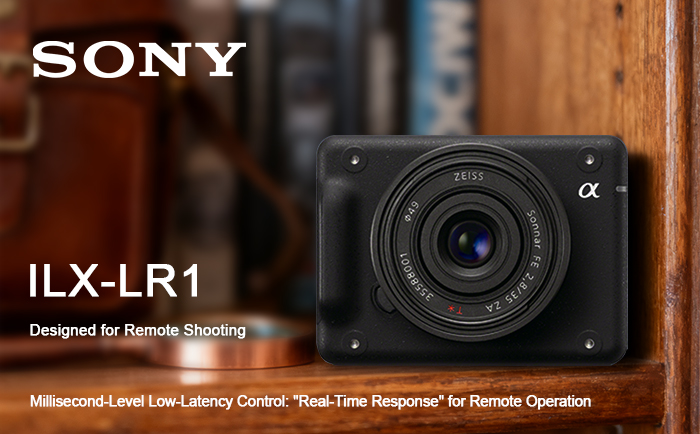
Ⅰ. Quick Response: Synchronization of Commands and Imaging
The core challenge of remote control lies in overcoming latency to ensure that control commands are immediately translated into camera actions. The ILX-LR1 has undergone in-depth hardware and protocol optimization for this purpose. Its dedicated 6Pin interface not only supports wide voltage (DC 10-18V) direct power supply, compatible with drone batteries, but more importantly, it optimizes the control signal path. This reduces the time difference from when a shutter command is issued from the ground station to when the camera actually completes the exposure to a low level.
This rapid response is of significant value in practical operations: in aerial photography tasks for 3D modeling, it ensures that the drone accurately triggers the shutter at each preset waypoint, avoiding image misalignment caused by delays and thereby enhancing the accuracy of the subsequent modeling. In scenarios such as power line inspections, it can reliably capture transient phenomena like arc discharges, providing crucial visual evidence for fault diagnosis. Technically, Sony's Camera Remote SDK's support for analog signal triggering further ensures the strict synchronization of shutter triggering with the drone's high-precision positioning data (such as RTK), enabling each frame of the image to carry reliable spatial coordinate information.
Ⅱ. Flexible Control: Comprehensive Remote Parameter Management
The
ILX-LR1 fully opens up the camera's control rights through an API (Application Programming Interface). After integrating Sony's Camera Remote SDK, users can deeply integrate camera control into their dedicated workflow software or ground station systems, achieving greater operational freedom.
Users can not only remotely set the basic exposure elements (aperture, shutter speed, ISO) to deal with sudden changes in light such as sunrise and sunset or entering and exiting shadows, but also perform more precise operations:
Focus management: In manual focus mode, the absolute focus position of the lens can be remotely read and locked. This is crucial for tasks that require shooting the same target from multiple angles for 3D reconstruction, ensuring that the focus of all images is exactly the same and avoiding model errors caused by focusing differences.
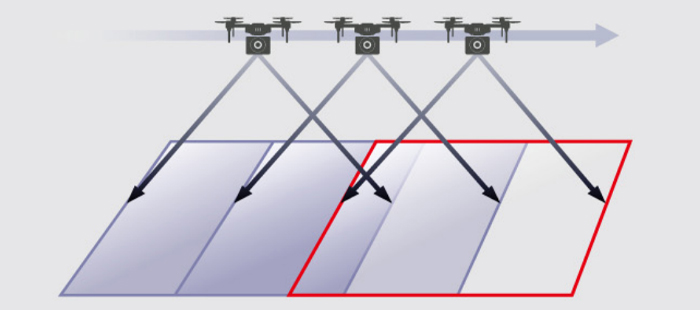
File and shooting logic control: Users can remotely select RAW format to retain maximum post-processing space or choose JPEG format to enhance operational efficiency based on task requirements. Additionally, users can flexibly set single shot, continuous shooting (approximately 3 shots per second), or time/distance interval-based timed shooting, perfectly catering to various needs ranging from dynamic construction records to wide-area static mapping.
III. Visualized Operation: The Assurance of Real-time Images
For remote shooting, the loss of the directness of the optical viewfinder makes the real-time monitoring image the "eyes" of the operator. The ILX-LR1 provides reliable visual feedback in two ways:
Hardware interface output: The Micro HDMI interface on the body can be directly connected to a monitor or a wireless image transmitter to transmit the camera's viewfinder image to the ground in real time.
Software integration preview: Through the SDK, users can directly embed a live view window within their own control software interface.
This feature significantly enhances the safety and success rate of operations. Operators can confirm the camera's perspective in real time, avoiding blind spots caused by installation errors or changes in the drone's attitude, and make timely adjustments. In complex lighting conditions or night operations requiring additional lighting, the angle and intensity of the supplementary lighting equipment can be precisely adjusted based on the real-time image to ensure the quality of the shooting.
IV. System Integration: Building an Automated Intelligent Workflow
The design philosophy of ILX-LR1 goes beyond that of a single device; it is intended to be a core sensor in an intelligent integrated system. Its body is equipped with standard M3 and 1/4-20 UNC screw holes, making it compatible with the mounting brackets of various drones, robots, and special vehicles, ensuring convenient and stable physical integration. The USB Type-C interface, which integrates data transmission and power supply, simplifies system wiring.
Summary
The Sony ILX-LR1 is not merely a full-frame camera with a 61-megapixel high resolution; it is an industrial imaging platform highly optimized for remote control and system integration. Through its rapid response, comprehensive control, intuitive monitoring, and open collaboration, it offers reliable, efficient, and future-oriented solutions for professional-grade drone mapping, industrial inspection, scientific documentation, and automated inspection, among other fields, facilitating the advancement of industries towards a higher degree of digitalization and intelligence.
 Sony FCB camera block