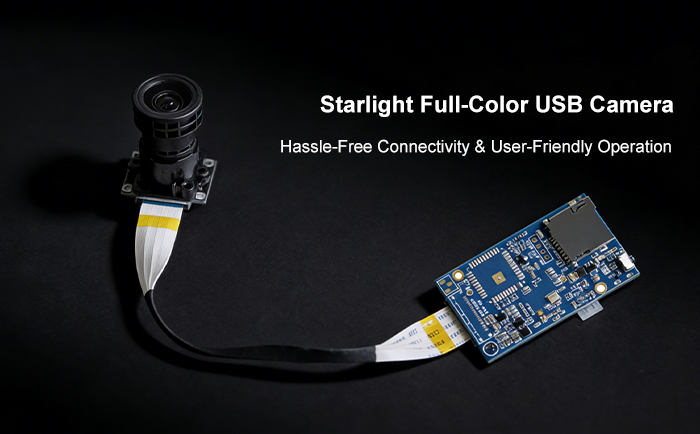
When night falls, traditional surveillance footage descends into a chaotic state of black and white with noise, and crucial color information - the true color of vehicles and the clothing features of people - vanishes. In the fields of security, inspection, and even scientific research, the demand for night imaging has long surpassed "being able to see" and has advanced to a new stage of "true color restoration". The emergence of starlight full-color USB cameras is turning this vision into reality. The core secret lies in the "duet of light and shadow capture" formed by large-aperture lenses and high-sensitivity sensors.
I. The Dual Harmony of Light and Shadow Capture: An Analysis of Hardware Foundations
To achieve full-color night vision, the primary challenge lies in capturing sufficient light signals. This depends on the collaborative breakthrough of two major hardware technologies.
The first level: Large aperture lens, a wide-mouthed bottle gathering faint light
The aperture, like the pupil of a lens, controls the amount of light entering. The smaller the F value, the larger the aperture opening. The F1.2 or larger aperture lens used in the Starlight Full Color USB camera means that in the same dim environment, it can capture several times more light than a common F2.0 lens. This is not only about enhancing the brightness of the image but has a more profound significance: abundant light signals are the original capital for the image processor to restore colors and extract details. A large aperture ensures that even in a starlight-like 0.0001Lux dim environment, there are still sufficient photons reaching the sensor, laying the physical foundation for generating pure and low-noise color images later on.
The second layer: High-sensitivity sensors, the canvas for converting photons
It's not enough to have sufficient light enter; how to efficiently convert weak light signals into clear electrical signals is crucial. Here, the size of the sensor and the pixel design become key.
Starlight full-color USB cameras often use a large 1/1.8-inch CMOS sensor. A larger "target surface" means each pixel can have a larger light-sensitive area. Unlike small sensors that are forced to reduce the size of each pixel at the same pixel count, large sensors can maintain high resolution while making each pixel a more efficient "light signal collector".
This highly sensitive sensor, especially when combined with advanced structures such as backside-illuminated (BSI), can enhance quantum efficiency and significantly reduce the noise amplified due to weak signals in low light conditions. It forms a closed loop with a large-aperture lens: the lens is responsible for collecting every trace of light in the environment to the greatest extent, while the sensor is responsible for converting these light signals into the starting point of image data with the highest fidelity.
II. From Signal to Image: The Empowerment of Algorithmic Wisdom
Outstanding hardware captures abundant raw data, but to transform it into usable and clear color images, an advanced image processing engine is still needed to "refine" it.
Under low light conditions, the sensor's raw data is mixed with a large amount of noise. At this time, the powerful 3D temporal noise reduction technology begins to work. It not only analyzes the spatial noise of a single frame, but also compares the changes of each pixel in consecutive multiple frames, intelligently distinguishing between real scene movement and random noise. Thus, it effectively suppresses the snow-like noise while retaining the dynamic details of the picture and avoiding trailing.

Subsequently, a series of intelligent image enhancement algorithms are initiated. The Wide Dynamic Range (WDR) technology processes scenes with significant contrast between light and dark, ensuring that details in the dark areas are visible while the highlights are not overexposed. To address the issue of reduced color saturation in low light conditions, a specific color restoration algorithm intelligently adjusts the color matrix, making the picture colors true and natural, rather than the color bias or loss of color often seen in ordinary cameras at night. The collaborative work of these algorithms ultimately restores the weak electrical signals captured by the sensor into a full-color night scene with rich details, accurate colors, and a clean picture.
III. Unveiling a Full-Color World: Transformative Application Scenarios
1. A Paradigm Shift in Security Monitoring: From "What's There" to "What It Is"
In the realm of security monitoring, full-color night vision has brought about a qualitative leap from merely identifying the presence of an object to discerning its specific characteristics. While black-and-white images might inform you that "someone passed by," full-color footage can clearly reveal "a person wearing a red coat and dark pants driving a white car passed by." The addition of color significantly enhances target recognition efficiency, the validity of evidence, and the speed of investigations, making it invaluable in fields such as criminal investigation and traffic management.
2. Accurate Perception in Intelligent Transportation
In road surveillance, color is a core information dimension. Full-color night vision capability enables the system to accurately identify license plate colors (blue, yellow, green, etc.), vehicle colors, traffic signal statuses, and pedestrian clothing colors at night, providing 24-hour, high-precision visual evidence for intelligent transportation management, violation determination, and accident analysis.
3. "Night Vision" for Drones and Robots
For drones conducting inspections, self-driving vehicles, or service robots, night vision capability directly determines their operational scope and reliability. The miniaturization and low power consumption of the starlight full-color USB camera make it easy to integrate. Drones can thus perform power line inspections and ecological monitoring at night, while robots can navigate and operate in dimly lit warehouses and shopping malls, expanding the application time and space boundaries of intelligent devices.
4. Microscopic Records of Research and Production
In scenarios such as continuous night-time biological research observations, unmanned monitoring of production lines, and auxiliary astronomical observations, full-color night vision capability enables a more comprehensive data dimension to be recorded. It can capture color change information that cannot be recorded in infrared or black-and-white modes, providing a richer data layer for analysis and research.
Summary
The combination of a large aperture lens and a high-sensitivity sensor is essentially an extension of human visual capabilities in the technological dimension. It breaks through the veil of darkness that obscures color information, restoring the night from a monotonous black-and-white world to a colorful space rich in information layers. This is not only an advancement in imaging technology but also a dimensional upgrade in perceptual ability. As the cost of this technology decreases and it becomes more widespread, it will move from professional fields to broader applications, continuously empowering every corner that requires clear, accurate, and colorful vision in the dark, truly making the night "visible" and "discernible".
 Sony FCB camera block