Under the shadowless lamp in the operating room, the chief surgeon needs to clearly see the fine vascular textures between tissues; on the automated production line, the detection system must identify the minute flaws on the product surface that are hard to discern with the naked eye; in border security surveillance, the night-time images need to penetrate the darkness while retaining sufficient details for identification.
The common challenge in these scenarios all points to the core of imaging technology - how to capture and present rich visual information under limited light conditions. Xuanzhan Technology, the official authorized dealer of Sony (China), stated that the FCB-ER9500 and FCB-EV9520L, these two professional camera modules, represent two different approaches to solving the problem.
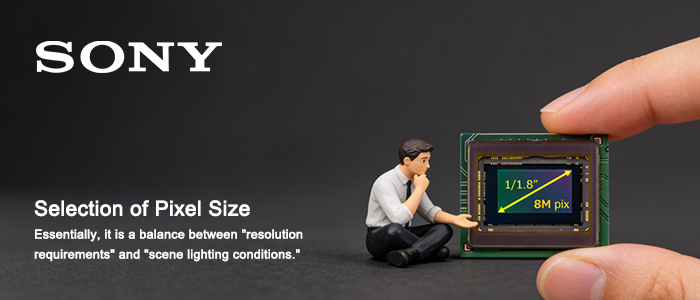
Unveiling the Imaging Secrets of Sony FCB-ER9500 and FCB-EV9520L: The "Picture Quality Code" Behind Pixel Size-1
Ⅰ. Pixel Size: The "Light-Sensitive Pockets" on the Sensor
Imagine that the sensor is like an array composed of countless "light-sensitive pockets", and each pocket is a pixel. They are responsible for capturing light and converting it into electronic signals.
The physical size of these "small pockets", that is, the pixel size, directly determines their ability to collect light. Larger pixels are like wider-mouthed containers that can "catch" more photons in the same amount of time, which brings two major advantages: higher signal-to-noise ratio and cleaner images in low-light conditions; and the ability to record a wider range of brightness, avoiding overexposure of highlights or complete blackness in the shadows.
However, technology is never a one-way choice. If one blindly pursues large pixels, with a fixed sensor size, only fewer pixels can be accommodated, and the resolution will be limited. Conversely, small pixels can achieve higher pixel density and capture more details, but they impose higher demands on algorithms and manufacturing processes.
II. Technical Showdown: Strategic Differences Between Large and Small Pixels
Sony's FCB-EV9520L opts for a "large pixel strategy". With a pixel size of 2.9 microns and a 1/2.8-inch sensor, it performs exceptionally well in low-light conditions. Official data indicates that it can still output color images in an environment with an illuminance as low as 0.009 Lux - roughly equivalent to the ground brightness when moonlight is partially obscured by thin clouds.
The dynamic range of Sony FCB-EV9520L reaches 130dB, surpassing the 120dB perception of the average human eye. This means that in scenes with strong backlighting or significant contrast in light, it can retain details in both the bright and dark areas simultaneously, avoiding the common issue with other cameras where "the bright areas are all white and the dark areas are all black".
So, is the
FCB-ER9500 with a smaller pixel size at a disadvantage?
The answer is not necessarily. The FCB-ER9500 is equipped with a 1/1.8-inch sensor. Although the pixel size is 2.0 microns, the larger total sensor area and 8.4 million effective pixels enable it to output true 4K ultra-high-definition images.
4K resolution means four times the pixel count of full HD, which is crucial in scenarios where details are highly demanded. Whether it's the tissue structures that need to be observed in telemedicine, the minute defects that must be detected in industrial inspection, or the facial recognition details in security, the FCB-ER9500 can provide more abundant information.
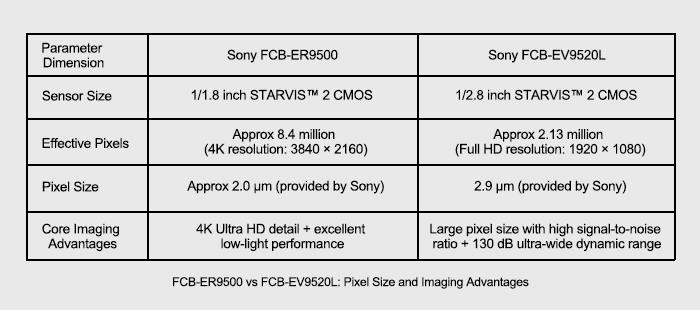
Unveiling the Imaging Secrets of Sony FCB-ER9500 and FCB-EV9520L: The "Picture Quality Code" Behind Pixel Size-2
III. Application Scenarios: Specialized Roles of Each Module
Choosing which module to use essentially answers a core question: In your application scenario, what is more important - the purity of image quality in low light conditions, or the richness of details at high resolution?
1.The Sony FCB-EV9520L is more suitable for:
Outdoor security monitoring with complex and changeable lighting conditions
Traffic monitoring scenarios that require a wide dynamic range
Integrated projects with strict limitations on equipment size and weight
Applications that need high-quality color night vision under normal illumination
2. Sony FCB-ER9500 is more competent for:
4K monitoring scenarios with strict resolution requirements
Identifying minute flaws in precision manufacturing and quality inspection
Medical imaging and remote surgical guidance
Broadcast video production and live streaming
Both the FCB-ER9500 and FCB-EV9520L are equipped with Sony's second-generation STARVIS™ 2 back-illuminated sensor technology. This technology places the circuit layer beneath the photodiodes, increasing the light-receiving area and significantly enhancing the light-sensing efficiency. This is the key reason why the FCB-ER9500 can maintain an outstanding low-light performance despite having a smaller pixel size.
IV. Integration Flexibility: The Last Mile of Technology Implementation
The value of professional imaging modules lies not only in their core performance but also in the convenience of their integration and application. For these two modules, Xuanzhan Technology, a provider of high-definition video secondary development solutions, has offered a variety of interface solutions.
The FCB-EV9520L can be paired with 3G-SDI, HD-HDMI, IP, SDI/HDMI/CVBS three-in-one or USB3.0 and other interface boards to meet the integration requirements of different systems. Meanwhile, the FCB-ER9500 can be optionally equipped with 4K60 HDMI, 12G-SDI, 4KP60AI network, 4K USB TYPE-C and other interface boards, fully unleashing its 4K performance potential.
Returning to the initial question: Does a smaller pixel size always result in poorer imaging? The comparison between these two Sony products shows that the essence of technical decision-making lies in the precise matching of application requirements and performance parameters.

Unveiling the Imaging Secrets of Sony FCB-ER9500 and FCB-EV9520L: The "Picture Quality Code" Behind Pixel Size-3
The
FCB-EV9520L, with its large pixel advantage, has established an insurmountable barrier in low-light and wide dynamic range scenarios; while the FCB-ER9500, with its higher resolution at the core, provides a solution for detail-oriented applications.
In the professional imaging field, the FCB-ER9500 and FCB-EV9520L are like different tools in a fine toolbox, each playing an irreplaceable role in their respective suitable domains. When you are making a choice, it might be a good idea to first ask yourself: What questions does the final image need to answer in my application scenario? The answer itself will guide you to the appropriate technical path.
 Sony FCB camera block