In the development of autonomous flight for drones, precise navigation for robots, and intelligent driving systems, the sensing capability of sensors is the core factor determining whether they can operate safely and reliably. Especially when facing the two extreme challenges of intense midday sunlight and complete darkness, many traditional sensing solutions often struggle to balance both aspects and encounter performance bottlenecks.
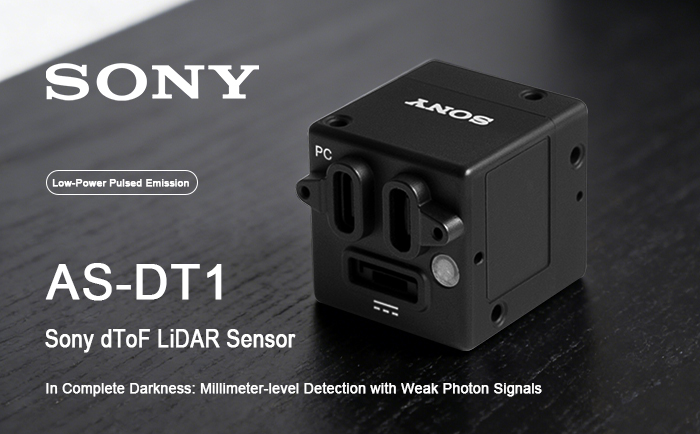
Sony's recently launched direct time-of-flight (dToF) LiDAR sensor AS-DT1, through a series of underlying technological innovations, claims to achieve stable and high-precision perception in both of these extreme conditions, providing a promising "all-round vision" solution for mobile intelligent devices.
1. Facing 100,000 Lux: Stable "Vision" under Intense Light
At midday outdoors, the ambient light intensity can reach up to 100,000 lux, which poses a severe challenge to distance sensors that rely on active light sources. Traditional indirect time-of-flight (iToF) technology is prone to signal saturation or confusion due to strong ambient light interference, significantly reducing or even rendering the distance measurement capability ineffective.
The AS-DT1 addresses this challenge from the perspective of sensing mechanism:
Single-photon-level detection sensitivity: This sensor employs a SPAD (Single-Photon Avalanche Diode) pixel array independently developed by Sony. This design enables it to detect extremely weak light signals at the single-photon level. Combined with high-precision time-correlated single-photon counting technology, the sensor can filter and identify the reflected signals of its own laser pulses through statistical methods from the vast amount of environmental photon "noise", thereby maintaining effective ranging functionality even under strong background light.
Anti-interference signal processing: In complex environments, light can be reflected multiple times, creating interference. The
AS-DT1 integrates advanced signal processing algorithms that can effectively distinguish direct reflected light from interfering light scattered through other paths. It is reported that within a 10-meter ranging range, its error in strong light environments can be controlled within the centimeter level, and its effective working distance outdoors can reach up to 40 meters.
II. Conquering Total Darkness: Revealing the Truth in Dim Light
In scenarios with no light or extremely low illumination, the laser pulses emitted by the sensor itself become the sole source of signal. At this point, the ability to capture extremely weak reflected light is of critical importance.
Efficient Light Signal Capture: Thanks to the back-illuminated SPAD pixel structure, the AS-DT1 has a higher photon absorption efficiency. Even when facing dark objects with extremely low reflectivity, it can capture sufficient photon information to complete distance calculation, achieving effective perception of various objects in the dark.
Pulsed Low-Power Operation: The dToF technology itself uses short-pulse lasers rather than continuously modulated light. This working mode means that the AS-DT1 only consumes high power during the measurement moment, significantly reducing the average power consumption. This is particularly beneficial for battery-powered devices such as drones and robots, offering longer battery life and ensuring continuous and stable operation in total darkness.
III. Industry Exhibition Debut and Response
The AS-DT1 sensor made its public debut at the 2025 Low Altitude Economy and Unmanned Systems Expo & Shenzhen International Drone Show, where it was showcased by partner Xuanzhan Technology, attracting significant attention from the industry. Subsequently, it was exhibited again at the China International Public Safety Expo held in the same year, sparking in-depth discussions among professionals from fields such as robotics, security, and automation.
IV. Empowering Diverse Frontier Applications
Its "all-weather" perception feature is giving rise to new application possibilities in multiple fields:
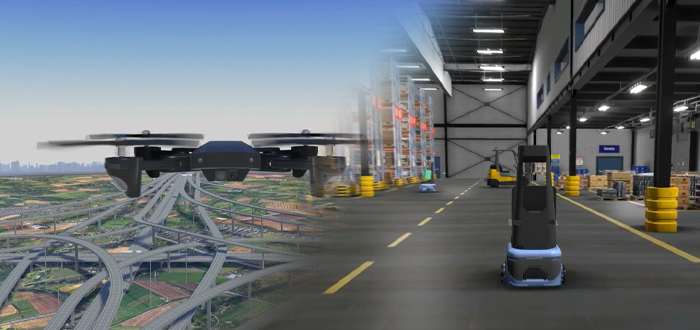
Drones and the low-altitude economy: Providing reliable close-range obstacle avoidance and precise landing capabilities for drones, especially enhancing the safety of autonomous flight in complex lighting conditions.
Robot autonomous navigation: In the context of warehousing and logistics, it can help AGVs (Automated Guided Vehicles) more clearly distinguish between fixed shelves, moving personnel and goods, achieving more intelligent path planning and obstacle avoidance. Mechanical arms can also accurately identify the target for grasping, avoiding misoperation.
Autonomous driving perception fusion: It can serve as an effective supplement to the main LiDAR system, focusing on high-precision and high-refresh-rate obstacle detection at medium and short distances. By fusing with other sensors, it builds a more robust perception network.
Industrial precision inspection: In the precision manufacturing fields such as 3C electronics and semiconductors, its high-precision features can be used for appearance inspection of components and identification of minute defects, assisting in the control of production quality.
Summary
The Sony AS-DT1 dToF LiDAR sensor, through SPAD single photon detection and advanced signal processing technology, aims to simultaneously overcome the two extreme perception challenges of strong light and total darkness, providing a high-precision and low-power 3D perception solution. Its emergence not only offers a more reliable perception foundation for existing applications such as drone obstacle avoidance and robot navigation, but also brings new imagination space to emerging fields such as AR/VR interaction, intelligent security, and medical imaging.
With the official launch of this sensor planned for the spring of 2026, a new phase of exploration into all-weather, highly reliable 3D perception technology and applications may be on the horizon.
 Sony FCB camera block